
In this article

A governance framework, also called a governance structure, is essential for today's governance and legal operations. Governance frameworks direct how people interact with the organization, regulators and stakeholders to guide and monitor operations closely. Yet, according to a 2025 McKinsey & Company study, 48% of companies have no formal corporate governance procedures.
A governance framework is a supporting structure for entity management and compliance, providing the trunk from which the various branches of compliant operations can grow.
Along with entity management technology, governance processes help companies and other organizations stay on the right side of regulators regarding filing requirements and aspects such as company culture, remuneration methods and transparency of operations.
A corporate governance framework helps to center an organization's approach around common themes, including who has a voice, who makes decisions and who has accountability.
The governance framework acts as an essential supporting structure, a framework of rules and practices by which the board ensures accountability, fairness and transparency in how the company runs and communicates with its stakeholders.
Here, we'll explain the key concepts that underpin corporate governance frameworks, including:
A governance framework is the system of rules, practices, processes and relationships that direct and control an organization. It defines which participants, including the board of directors, management, shareholders and stakeholders, have which rights to set objectives, make decisions, monitor performance and promote accountability.
The terms 'governance framework' and 'governance structure' are interchangeable. They both describe the governance system of an organization, particularly the rules, procedures, roles and responsibilities that influence it.
These frameworks or structures most often govern people in positions of authority, such as executives and the board of directors. They dictate how they will complete the activities that drive the organization forward.
Every effective governance framework establishes clear accountability across three critical dimensions:
First, it defines decision rights, specifying who has authority to make strategic, operational and oversight decisions.
Second, it creates information flows that ensure the right people receive relevant data at the right time for informed decision-making.
Third, it builds accountability mechanisms that connect decisions to outcomes and consequences.
"As a board member, it's crucial to get familiar with the operational heartbeat of the business," says Pav Gill, CEO of Confide. "Step down from the boardroom and immerse yourself in the company's day-to-day workings. Many board members operate from a high-level perspective, but without understanding the granular details, it's hard to connect fully with the challenges the organization faces."
Discover why a holistic approach to GRC is crucial for managing risks and ensuring compliance across your organization.

Organizations should have a single governance framework that views roles, responsibilities and decision making holistically.
However, within that framework, organizations can tailor their governance process to specific domains, ensuring critical functions have proper oversight.
Once a framework is in place, the next question is where it sits on the maturity curve. Most organizations move through five stages, and recognizing your stage matters more than the label itself, because each stage has a different highest-value next move.
Mapping your current state against this spectrum helps identify the two or three moves with the largest effect, rather than attempting a full redesign at once.
Governance frameworks and processes aren't universal. How an organization governs itself depends heavily on the cultural norms, laws and regulations of its jurisdiction. Here are some key ways governance frameworks can differ.
Shareholder orientations are common in the U.S. and UK, where the primary duty of the board and executives is to maximize value for shareholders, primarily investors and owners. Stakeholder orientation takes a broader view of value creation, considering the interests of employees, customers, communities, the environment and shareholders. This model is more common in Europe and some parts of Asia.
Your board structure influences the role of independent oversight and how you manage conflicts of interest. One-tier boards have executive (company management) and non-executive (independent) directors; this is typical in Anglo-American systems. On the other hand, two-tier boards establish a management board to run the company and a supervisory board to oversee management. This is the structure of choice in Germany and some European countries.
Governance processes in some countries are more mature and consistent than in others. The U.S. and UK are known for their formal governance practices with clear, codified rules and best practices that lead to consistency; this includes well-documented codes like the UK Corporate Governance Code and the Sarbanes-Oxley (SOX) Act in the U.S.
Others, like countries in the Asia-Pacific Region, are maturing rapidly, though practices still vary widely across countries.
Governance worldwide also varies by how it's enforced. The U.S. relies heavily on legal compliance and litigation risk through the Securities and Exchange Commission (SEC) and legislation like SOX.
The UK, Canada and Australia, meanwhile, use comply-or-explain governance, which is less punitive and more principles-based. Governance frameworks in countries like Japan and Korea are newer and, therefore, still evolving.
Governance processes must also be responsive to changes in the business landscape, but some countries are better at keeping pace than others.
The EU AI Act is widely viewed as the most far-reaching risk-based AI regulation to date, and related governance frameworks are developing fast. AI regulation in the U.S. has so far been fragmented, which has supported vast innovation.
Across APAC, AI governance is evolving unevenly. Some markets are prioritizing digital infrastructure and basic data governance first, while others are beginning to issue AI-specific guidelines alongside broader digital reforms. According to the APAC Governance Outlook 2026 from Diligent Institute in partnership with the Governance Institute of Australia and Singapore Institute of Directors, 65% of APAC respondents cite a lack of governance processes to guide agentic AI decision-making as a top concern.
The above cultural, regulatory and legal differences spill over into the distinct frameworks that apply to the region. Many of these are voluntary or on a comply-or-explain basis, but they remain critical guides to integrating strong governance practices.
Explore what's shaping boards globally in our 2026 corporate governance trends overview.

Good corporate governance structures can make organizations more competitive. With good governance processes, organizations ensure all their activities are consistent and up to regulatory standards, assuring the board that their rules and systems improve the business.
Examples of strong governance structures include:
The General Data Protection Regulation (GDPR) is a legal example of strong data governance enforcement. In line with the regulation, companies must implement data protection officers, privacy-by-design principles and rigorous consent management.
A strong corporate governance framework organizes operational, risk management, reporting and financial processes to ensure the board is continually updated.
Rules and systems create a robust framework for governance, and the framework provides the structure that drives the strategic plan. A strong governance structure can:
These outcomes are what make the framework the operating system for the board, not just a compliance document.
A sound governance framework can have a far-reaching impact. Though governance is most commonly a topic in the boardroom, it has a ripple effect internally and externally. Organizations that successfully execute a governance framework can expect:
A robust governance framework includes processes for identifying, assessing and managing risks, contributing to better risk management practices. Robust compliance mechanisms, ethical guidelines and risk management practices can steer companies away from regulatory violations and litigation and toward sound performance.
According to the Q4 2025 GC Risk Index from Diligent Institute and Corporate Board Member, legal and compliance leaders rated business risk at 7.9 out of 10, a 16% increase from Q1.
Organizations with effective governance processes are better positioned to navigate these elevated risk levels through proactive compliance measures and scenario planning.
A corporate governance framework promotes transparency by offering stakeholders clear insight into the company's operations, finances and decision-making. Transparency builds trust, which in turn engenders loyalty to the organization.
"There's often an inclination to avoid bad news, with a hope that problems will be resolved before they escalate to the board level," says Gill. "But boards should proactively request access to whistleblowing reports. It's essential to see firsthand how robust and effective the current mechanisms are. Only then can you be confident in the integrity of your compliance framework."
Organizations with a sound governance framework define the roles, responsibilities and processes that guide informed decision-making. Timely board decision-making leads to a better allocation of resources and long-term sustainability.
Stakeholders are central to corporate governance frameworks, particularly the stakeholder model. Organizations can prioritize stakeholder interests, ensure ethical treatment and build trust with an effective framework.
For investors and consumers, corporate governance is a calling card for a well-managed, ethical company. That reputation benefit makes it easier for organizations to attract capital and loyal customers, boosting their long-term performance.
Business advisory firm PwC calls corporate governance "a performance issue" as it provides a framework for how the company operates, stating that corporate governance frameworks should encompass the following:
This list provides a bird's-eye view of corporate governance in action and conveys how it can influence business. To help organizations navigate corporate governance, Deloitte offers a governance framework that outlines the board's objectives and responsibilities and how they relate to the corporate governance infrastructure.
Governance frameworks exist to ensure that a company remains in compliance and operates within legal boundaries, meaning that any governance structure must consider the local regulations wherever the organization has entities. The governance framework then dictates the governance operating model appropriate to the organization's aims.
To start building your own governance framework, aim to answer these questions:
Answering these questions gives you the raw material for the step-by-step build.
A well-designed governance framework should bring structure and clarity to your organization's decision-making. Here, we'll walk you through the key stages of building a governance structure, whether you're creating an enterprise-wide framework or focusing on a specific area like AI or data.
Start by asking, "Why are we building this framework, and what will it cover?" Identify the motivators, whether regulatory compliance, ethical concerns or risk exposure, and determine whether your framework applies organization-wide or to a specific function.
Map out the people and functions that will design, implement and uphold the framework. This could be board members, executives, technical team members or compliance officers. What matters is that you clarify who is responsible, who is accountable and who should stay informed. In documenting this, you will have developed an organizational chart with role definitions.
Now that you know who will make decisions, you need to define how they will make them. Consider the values and rules that shape decision-making: fairness, transparency, accountability or something else. Your policies can also spell out acceptable data use, ethical AI deployment or board composition requirements.
Define the processes that support the decision-making you've outlined. How are new initiatives approved? What happens when issues arise? Who has the final say? Document these workflows to ensure accountability and reduce ambiguity.
Put tools in place to measure effectiveness, monitor risks and ensure compliance. This includes key performance indicators, audit mechanisms and remediation workflows.
No governance framework is effective unless people understand and adopt it. Build internal buy-in through training, transparent communication and easy-to-access documentation. Help teams understand the why and how of governance, so it becomes part of the culture.
Governance should evolve over time. Regularly review policies, roles and effectiveness using audits and feedback to refine your governance model as your organization grows or the landscape changes.
Building a framework is only half the work. Measuring it tells you whether it is actually producing the accountability and decision quality it was designed for. Useful indicators typically fall into four categories:
Board decision cycle time measures how long it takes from issue identification to documented board decision. It is the most direct test of whether your information flows and decision rights are actually working. Track it for material decisions only, things that required board or committee approval, not every operational item.
A long cycle time is rarely caused by directors deliberating too carefully. More often, it reveals a structural problem upstream. Items might be reaching the board half-formed because pre-read materials lack the analysis directors need. Decision rights may be unclear, sending an item to the wrong committee first. Information could be flowing through too many hands before it reaches the board agenda. Each of these has a different fix, so the diagnostic value comes from segmenting the data, not the headline number.
A cycle time that is too short can also be a warning sign. If material decisions are being approved within days of first appearing in board materials, it suggests directors are rubber-stamping rather than challenging.
Aim for cycle times that match the risk weight of the decision. Routine approvals should move quickly. Strategic, capital-intensive or reputationally sensitive decisions should take longer, with that time visibly spent on questions, scenario analysis and committee review rather than scheduling.
Compliance incident rate captures the number and severity of compliance breaches, whistleblowing reports, regulatory findings and near-misses over a rolling 12 months. Severity matters as much as volume, so weight each incident by its potential or actual impact rather than counting them flat.
The direction of the trend tells you more than the absolute number. A rising rate could mean controls are weakening, but it could also mean detection is improving as a new policy or whistleblowing channel matures. A falling rate could mean genuine improvement, or it could mean people have stopped reporting because they have lost confidence in the process. Read the rate alongside whistleblowing channel usage and time-to-resolution data to tell those stories apart.
Pay particular attention to repeat incidents in the same business unit, geography or process. A pattern of the same kind of breach recurring after remediation is a sign the framework's accountability mechanisms are not closing the loop. Pav Gill's point earlier in this article about proactively requesting access to whistleblowing reports applies here: the data is only useful if the board sees it without being asked.
Audit finding trends look at whether internal and external audit findings are declining in frequency and severity year over year, and how quickly remediation happens. Track open findings by age (under 30 days, 30 to 90 days, over 90 days), not just count. A growing tail of older findings is one of the clearest signals that a governance framework is failing to convert oversight into action.
Consider three views of the same data:
Use this data to refine the framework itself, not just to remediate individual findings. If audit findings cluster around the same committee or geography year after year, the issue is likely structural.
Director engagement uses meeting attendance, material read-through rates, committee participation and depth of discussion as proxies for whether the framework genuinely supports oversight. Engagement signals that should prompt a closer look include consistently late material distribution, low read-through rates on key documents, the same one or two voices dominating discussion or directors arriving without questions on material items.
Read engagement data carefully. Low read-through rates on a 400-page board pack are usually a problem with the pack, not the directors. If meeting attendance is high but discussion stays shallow, the issue may be that pre-read materials are too long, too late or insufficiently analytical, leaving directors no realistic path to come prepared. Committee chairs should also have a view on whether their members are bringing genuine challenge to the work, since attendance alone does not capture quality of contribution.
When engagement metrics weaken, the response is rarely to push directors harder. It is usually to fix what reaches them: shorter materials, earlier distribution, sharper analysis, clearer questions surfaced in advance.
Review these indicators at least annually, and ideally have committee chairs sight them quarterly alongside the data their committees already see. No single metric is meaningful in isolation; the value comes from reading them together. Short cycle times paired with rising audit findings, for example, suggest the board is moving fast but missing things. High director engagement paired with a flat compliance incident rate may simply mean detection is weak.
Frameworks that go unmeasured tend to drift back toward the ad hoc end of the maturity spectrum. Pick the cut of each indicator that fits your governance maturity stage today, and revisit the cut as the framework matures.
Governance for SMBs may not involve a formal board of directors or complex committees, but that doesn't make it any less important.
A clear, well-designed governance structure can help SMBs make better decisions, reduce risk, build credibility with investors or partners and scale more sustainably.
A growing business might have a governance structure that includes:
Even lean teams benefit from documenting these elements early rather than retrofitting them during a funding round.
A robust governance framework guides an organization toward accountability, authority and sound decision-making. By contrast, a weak corporate governance framework will disrupt the investment process and affect overall economic growth.
For portfolio companies, a governance structure should ensure that all shareholders can vote on governance matters. All shareholders should have a voice and foundational rights.
Portfolio companies should conduct business concerning both the shareholders' interests and the capital entrusted to them. A portfolio company's governance structure should take the following into account and demonstrate:
A portfolio company's governance structure should ensure adherence to the above commitments as the organization carries out its responsibilities as a market participant.
It's natural for corporations to seek to establish new entities to fuel business growth and deal with increasingly complex regulations, but with each new entity comes a heightened need for entity management and robust subsidiary governance.
Globalization raises legal and corporate governance issues at the subsidiary level that need constant attention. To deal with this, many company secretaries and legal operations professionals turn to a subsidiary governance framework template to help get things under control.
Corporate governance framework templates provide guidelines and ideas to ensure both downstream and upstream corporate governance flows are robust and compliance-proof.
A subsidiary governance framework template can help to align processes while allowing wriggle room for local action.
It provides the framework for those responsible for subsidiary governance processes and entity management to determine what works best for them and their needs, while ensuring the policies and practices generally conform to what the parent company expects.
This means that the parent company can focus on group-level requirements and issues, work to grow the business further and devise long-term strategies. At the same time, the subsidiaries can work out the part they need to play and how that works at a jurisdictional level.
It's not practical to assume the parent will take care of every subsidiary's regulatory and compliance needs; any subsidiary governance framework template must lay out the roles and responsibilities of both the parent and each subsidiary.
The Chartered Governance Institute (CGI) has developed an "at a glance" subsidiary governance framework template checklist to help corporations operating across multiple jurisdictions and business areas.
Once an organization decides to list and go public, its compliance and governance burden increases significantly. Now, it's no longer just a company's stakeholders and potentially the local authorities keeping an eye on how the organization is running; once it is listed, that organization becomes public property. It's opened itself up to intense scrutiny.
Market fluctuations will impact its share price, but scrutiny can also impact the price. The movements and decisions of the board will be publicly available for access by anyone with a genuine interest, and investors will have the opportunity to ask questions and express concern about business operations. This is why public entities need robust and sound governance practices.
Strong governance structures can help mitigate some of those risks, ensuring that everyone in the business, as well as the market and investors, knows the organization's steps. It means transparency around compliance and operations is supported by clear communications, and a paper trail can lead back to the reasons for any decisions and the ultimate consequences.
A public entity must report to the market regularly. A schedule of reporting on board meetings and accounts, management changes, security breaches and more will be expected, as will a detailed annual report. If they don't get filed with the exchange, then the public entity, and potentially its parent, will face sanctions and fines.
As public entities develop and monitor their governance structures, they are, in essence:
And, of course, any corporate governance framework should be subject to regular audits to ensure it's still fit for purpose, providing the proper checks and balances.
Data has long been central to how businesses operate and make decisions. However, AI has made data even more essential. Embedding both into your governance framework is critical to ensure both the responsible use of data and AI and that you're well-positioned to reap the rewards.
The EU AI Act is a particularly useful anchor. Its risk-based tiers (prohibited, high-risk, limited-risk and minimal-risk systems) give organizations a ready-made taxonomy for classifying AI use cases, assigning human oversight and documenting conformity assessments. Teams outside the EU are adopting similar categories to future-proof their framework against parallel AI regimes in the U.S., U.K. and APAC.
To truly strengthen your governance framework, you need to put AI and data to work so your structures are smarter, faster and more adaptive. Here's how:
What boards do with these tools matters as much as the tools themselves, especially as AI regulation expands.
"Have a candid assessment of what your board's capabilities are… The board needs to apply an appropriate level of governance pressure to someone who's going to oversee the AI landscape, the risk exposure, the disruption and the opportunity," says Keith Enright, VP and Chief Privacy Officer at Google and Board Director at ZoomInfo.
Manual board preparation consumes weeks of staff time each quarter. Documents get compiled from scattered sources. Risk scanning happens through manual review, and directors receive materials too late for meaningful preparation.
This administrative burden shifts focus from strategic oversight to logistics management.
AI-powered governance platforms eliminate these bottlenecks. The technology synthesizes information, identifies compliance risks before publication and generates strategic discussion frameworks, transforming governance from a resource-intensive process into an efficiency multiplier.
Here's how Diligent supports this governance transformation:
Across all growth stages, Diligent Boards delivers AI-driven efficiency that transforms how boards prepare for and conduct meetings:
For growing companies, the platform professionalizes board operations without dedicated governance staff, establishing audit-ready processes that build investor confidence during funding rounds.
Pre-IPO organizations benefit from IPO-ready governance infrastructure that demonstrates governance maturity during transaction-readiness assessments.
Large organizations optimize sophisticated board operations with seamless integration into existing governance tech stacks, including S&P Global Market Intelligence and DocuSign, for board intelligence that meets stakeholder expectations.
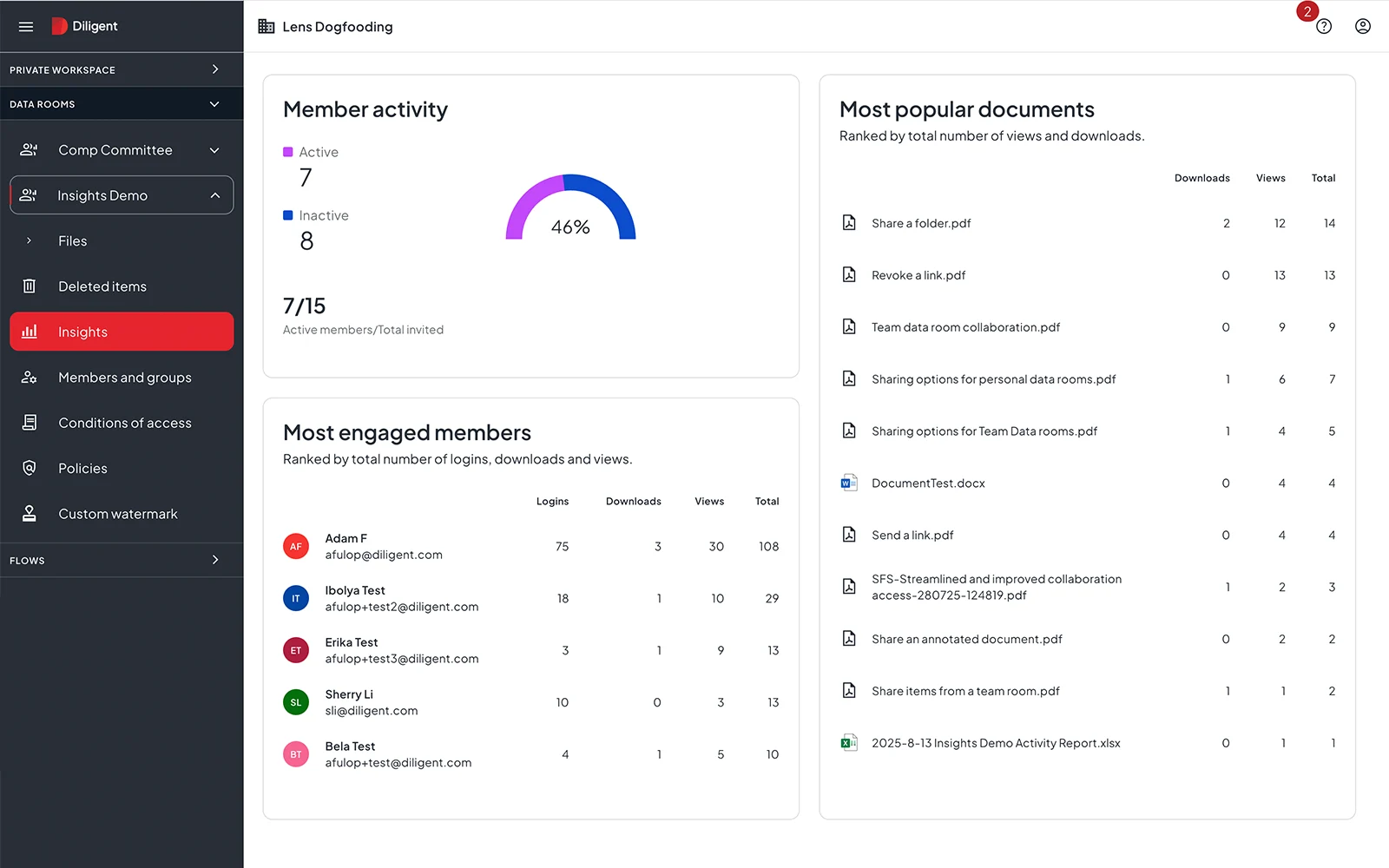
For organizations managing complex subsidiary structures, Diligent Entities provides centralized governance across multiple jurisdictions and business areas.
The platform brings stakeholder information and entity data to a central repository that's easily accessed from anywhere, critical as more board members, executives and employees work remotely.
This entity management capability supports the subsidiary governance framework templates that CGI recommends, enabling corporations to maintain consistent governance standards while allowing jurisdictional flexibility.
Both products sit on the broader Diligent One Platform, which connects board management, risk, compliance, audit, entities and market intelligence in a single governance system.
General counsels and corporate secretaries live with the governance framework every day. It is the document you pull up when a regulator calls, the structure that decides who approves a subsidiary filing at 9pm and the reason a director can walk into a meeting already knowing what to ask. The regional nuances, maturity stages, KPIs and AI considerations covered above all converge on the same daily reality: whether the right information reached the right people in time for a good decision.
The gap between knowing what good governance looks like and executing it consistently across time zones, entities and committees is the tension most governance leaders live with. Policies live in one system, entity data in another, board materials in a third. The framework only earns its keep when those pieces connect.
See how Diligent brings governance, risk, compliance and entity data into a single AI-assisted view. Request a demo to see Diligent in action.
A governance framework is the system of rules, practices, processes and relationships that direct and control an organization. It defines which participants, including the board of directors, management, shareholders and stakeholders, have which rights to set objectives, make decisions, monitor performance and promote accountability.
A well-designed framework covers decision rights, information flows and accountability mechanisms, and it typically integrates related domains such as risk, compliance, data and AI governance.
A governance framework provides the structure, policies and processes that guide how organizations make decisions, manage risks and uphold accountability. It helps organizations align strategy with ethical standards, regulatory requirements and stakeholder expectations.
Strong governance frameworks improve transparency, reduce risk and foster long-term sustainability, making them essential for organizations of any size or sector.
An AI governance framework is the set of policies, processes, controls and oversight mechanisms that guide how an organization develops, deploys and monitors artificial intelligence. It typically covers ethics, transparency, accountability, data quality, human oversight and compliance with regulations such as the EU AI Act, alongside emerging AI laws in the U.S., U.K. and APAC.
A well-built AI governance framework also defines who approves new AI use cases, how risks are classified and tested before deployment and how ongoing performance and bias are monitored once a model is in production.
A typical governance framework includes:
Together, these elements define who decides, how they decide and how those decisions are tracked. Missing any one of them tends to produce the governance gaps regulators and investors notice first.
The OECD Principles of Corporate Governance are global, policy-oriented guidelines emphasizing shareholder rights, board effectiveness and transparency.
South Africa's King IV is a principles-based framework focusing on ethical leadership, sustainability and inclusive stakeholder governance.
While both aim to strengthen governance, the OECD is more structural and investor-centric, while King IV is holistic and values-driven.
Rules-based frameworks prescribe specific, legally binding requirements (e.g., Sarbanes-Oxley in the U.S.).
Principles-based frameworks provide flexible, high-level guidance (e.g., the U.K. Corporate Governance Code or King IV), allowing organizations to tailor implementation based on context.
Rules-based models prioritize compliance; principles-based models emphasize accountability, transparency and values.
To create a governance framework:
Most teams benefit from starting narrow, proving the model in one committee or function, then expanding.
Multinational companies benefit from a hybrid governance framework that aligns global best practices with local regulatory requirements. Many use:
A strong multinational framework is flexible, culturally aware and capable of scaling across legal and operational contexts.
Yes, modern governance frameworks increasingly integrate ESG, AI governance and data governance.
Including these elements strengthens risk management, builds stakeholder trust and future-proofs the organization.
Modernize your governance framework today. Schedule a demo to see how AI-powered governance platforms deliver efficiency, transparency and strategic insight across all growth stages.