
Every compliance leader has had this moment: a board member, an auditor or a regulator asks a simple question, "how do you know your program actually works?", and the honest answer requires pulling data from four or five different places that don't talk to each other.
Conflicts of interest sit in one spreadsheet. Training completion sits in an LMS. Policy attestations live in a shared drive or an email chain. Speak up cases sit in a case management tool, if they're tracked systematically at all.
Each of those systems might be working fine on its own. The problem is what happens between them: nothing. No shared view, no shared signal, no way to see that a spike in one area often explains a gap in another.
This is the starting point for a short series we're publishing over the coming weeks.
Each chapter of the series looks at one part of a compliance program that, in isolation, feels like its own project with its own deadline and its own owner. Read together, they add up to a single idea: the fix for a fragmented compliance function isn't another point tool. It's connecting what you already have.
Here's what the series covers and why that matters:
Most conflict of interest programs still run on an annual survey and a shared inbox. That works, right up until a conflict emerges in month four and nobody notices until month twelve, when it's already shaped a hiring decision, a vendor contract or a deal. Static, once-a-year disclosure cycles were built for a slower pace of business than most organizations operate at today.
COI issues rarely announce themselves. They surface later, in an audit finding or a headline, by which point the question isn't "did we have a policy" but "why didn't we catch this."
That kind of visibility invisible gap doesn't stay contained to conflicts, either. It shows up just as easily in something every organization already runs at scale: compliance training.
Training completion rates look great on a board slide. They tell you almost nothing about whether anyone changed how they act. Employees click through slide decks to clear a compliance box, not because the content connected to their actual job, and compliance teams are left with a metric that proves activity, not impact.
Training is where most programs quietly lose their return on investment. The infrastructure is there (courses assigned, completions tracked), but the outcome it's supposed to produce (better judgment, fewer repeat violations, earlier questions) isn't being measured at all.
And that same gap runs somewhere else too, into the policies training is supposed to reinforce.
A policy that employees can't locate, don't understand or have never attested to isn't really a policy. It's a document. Yet policy management is still, for a lot of organizations, a mix of shared drives, email version chains and a review cycle that only compliance can trace.
Policy is the connective tissue that's supposed to run underneath everything else. Training references it, speak up investigations cite it, COI decisions depend on it, and when it's disorganized, every downstream process inherits that disorganization.
Nowhere does that show up faster than in the channel meant to catch what everything else missed: speak up.
Employees consistently say they'd report misconduct if they saw it. Reporting volumes tell a different story. The gap isn't a lack of concern, it's a lack of trust that a legacy hotline will actually do anything with what's reported, or protect the person who spoke up.
Speak up data is often the earliest warning signal a compliance program has access to. If a report about a conflict of interest, a training gap or a policy violation surfaces through a whistleblower channel before it surfaces anywhere else, that's a sign the other three systems weren't catching it fast enough on their own.
Put these four areas side by side and the same shape repeats: a real risk exists, the organization has some system for tracking it and that system operates in isolation from every other system that touches the same underlying risk.
A conflict of interest that should have triggered a policy review doesn't, because COI and policy live in separate tools. A training gap that should show up in speak up trends doesn't, because nobody's connected training completion to case data. Each function is defensible on its own terms and disconnected from the others in practice.
That's the foundation this series builds toward: a compliance program is only as strong as the connections between its parts, not the strength of any single part in isolation.
Governance and risk teams in many organizations are already living through this transition.
Boards now lean on AI that surfaces relevant context and expert perspective before a meeting even starts. Risk teams run AI agents that turn a live risk register into a board-ready report in minutes instead of days. Third-party integrity teams are moving from static vendor questionnaires to AI that requests and validates evidence automatically, rather than chasing it by email.
Compliance is next in line for that same shift, and it depends on the same precondition every one of those examples shares: AI can only reason across data it can actually see.
A system that's meant to connect a speak up report to the relevant policy, the training history and the entity's risk exposure only works if those four things already sit in a connected environment. Fragmented tools don't just make manual oversight slower. They make automated oversight impossible.
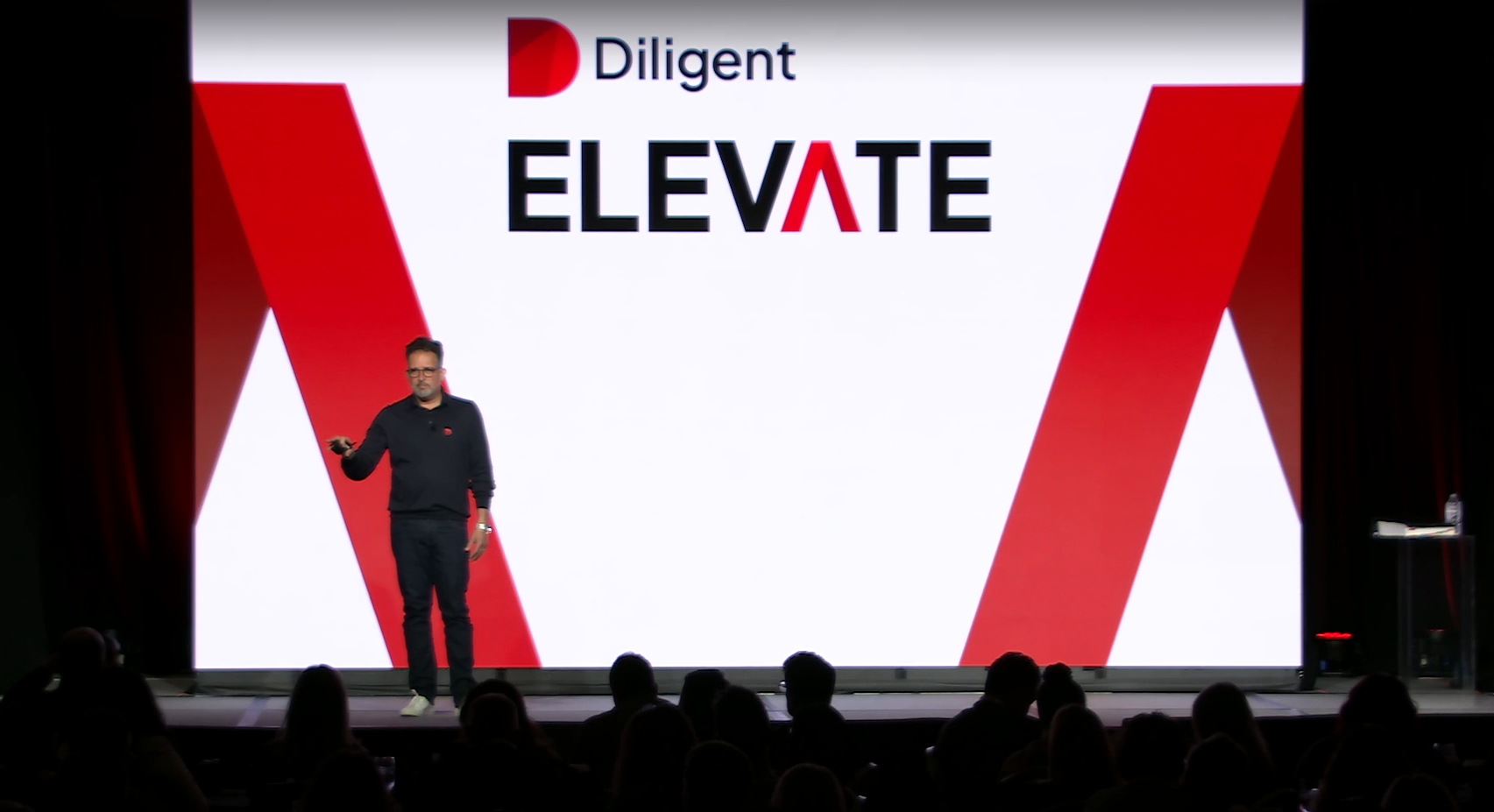
That's not a hypothetical. At the recent Elevate 2026 conference, Diligent's leadership team described exactly this reality: an AI layer that, the moment an employee raises a concern, immediately maps the entity, the jurisdiction, the relevant policies, training history and watchlist exposure, surfacing the full picture in minutes.
Watch the teaser announcement from Elevate 2026 👇
The connected foundation this series has walked through, conflicts, training, policy and speak up, is exactly what that kind of intelligence needs underneath it to work.
We'll bring the whole idea together in the weeks ahead: what it actually looks like to run conflicts, training, policy and speak up as one connected system rather than four separate projects, and how that connected foundation is already starting to power AI-driven compliance intelligence.
Top 5 AI innovations for governance, risk and compliance announced at Elevate 2026

Discover the future of governance, risk, and compliance with Diligent's groundbreaking AI innovations unveiled at Elevate 2026. From transforming boardroom dynamics with the AI Board Member to streamlining enterprise risk reporting and enhancing vendor due diligence with Lexi, these tools are designed to empower GRC professionals by reducing manual tasks and increasing strategic impact. Join our early adopter programs today to be at the forefront of this revolution.

From hotline to speak-up culture: Change management for modern whistleblowing
Explore how to transform outdated hotline systems into robust, AI-driven speak-up programs that meet modern regulatory demands. This guide provides compliance and legal leaders with a practical roadmap to enhance whistleblowing practices, ensuring early issue identification and reporter protection. Download now to begin your transition to a strategic speak-up culture.