
In this article

Boards and organizational leaders have more to do than hours in a day. Saving time is one way to improve their effectiveness. Routine approvals can crowd out the planning and oversight conversations directors most need to have, and a consent agenda gives boards a structured way to move recurring, noncontroversial business quickly while preserving time for deliberation and oversight.
The role of the corporate secretary includes helping a board chair or CEO prepare for a board or executive meeting. Each leader has to prioritize agenda items, which can be especially challenging as many items vie for attention.
Many of the items are routine in nature, and there's a way to address them during a council meeting that helps get through them faster.
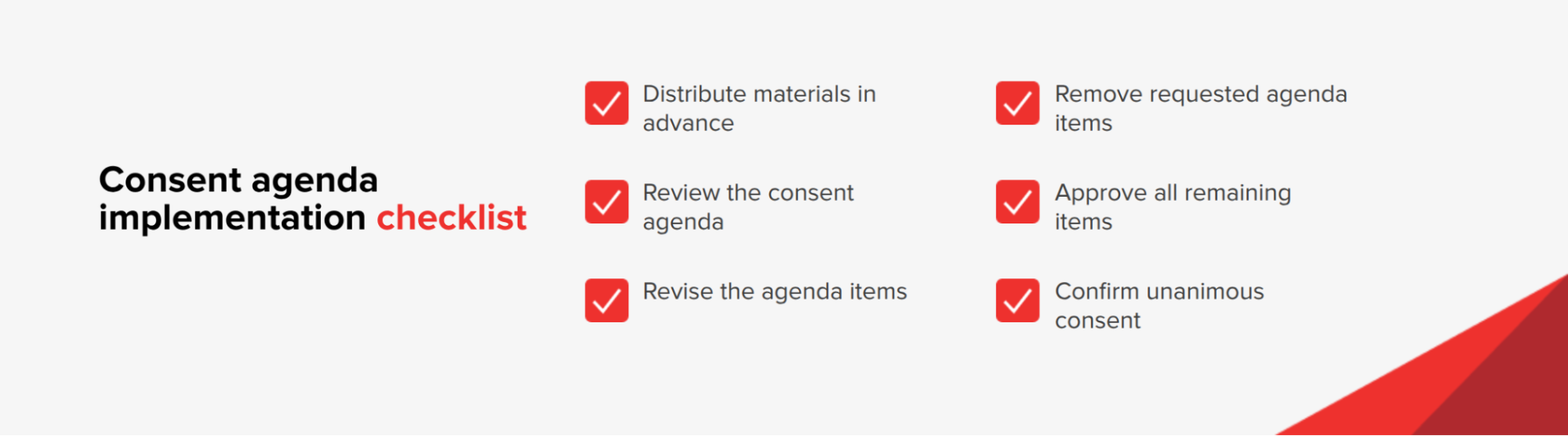
Consent agendas require advance materials and clear removal rules:
Also known as a consent calendar, a consent agenda is a time-saving tool that keeps council meetings well-organized and efficient. A consent agenda groups routine meeting agenda items into one agenda item. It doesn't require motions on each item. The board can pass or approve everything in the consent agenda with one motion.
Despite its simplicity, only 9% of boards use consent agendas, according to a 2022 Deloitte Board Practices Quarterly. For boards that repeatedly run out of discussion time, that low adoption rate points to an immediate operational opportunity.
Start by reviewing recent agendas and identifying recurring approvals that generated no discussion. Those items are strong candidates for a consent block, provided members retain the right to pull them for separate consideration. In the Diligent Institute's What Directors Think 2026 survey, 58% said they want more time for planning or dedicated planning meetings, and a well-run consent agenda is one of the simplest structural changes that creates it.
Routine approvals often consume meeting time even when they require no discussion. Many agenda items need approval or a vote even though everyone already agrees on them.
BoardSource estimates that a consent agenda can cut review of routine approvals from an hour to five minutes by eliminating individual motions and votes. This process frees up meeting time for discussions about matters that require the most time, attention and deliberation, such as how the group can advance planning that will impact the lives of their customers and employees.
Consent agendas group routine items for board approval in a single vote. This works by:
The parliamentary basis for this process comes from Robert's Rules of Order. Section 41:32 of the 12th edition describes the consent calendar as a tool for assemblies with "a heavy work load including a large number of routine or noncontroversial matters," and provides that a special rule of order may allow those matters to be "considered in gross or without debate or amendment," per the Robert's Rules of Order Newly Revised text. Boards must adopt a rule of order before using consent agendas. For a closer look at the broader body of parliamentary procedure this draws on, see Lexology's overview of consent agenda rules.
Boards put specific items into their consent agendas. Include routine or recurring items, procedural decisions, non-controversial issues and items that the board has already aligned on but still needs to put to a formal vote.
Examples of consent agenda items may include the previous meeting's minutes, informational reports, the executive's report, program reports, department reports, committee appointments, and staff appointments that require board confirmation.
Some items should never appear on a consent agenda. BoardSource advises that financial statements should not be included, and the Municipal Research and Services Center (MRSC) excludes audit reports, significant financial reports and major strategy or policy decisions because of their importance and need for detailed discussion.
A consent agenda is a single grouped item within the regular agenda. On the regular agenda, each item receives its own introduction, discussion and vote. On the consent agenda, routine items are bundled together, distributed in advance and approved through one motion without debate.
Meetings spend time differently depending on where an item sits. Items on the regular agenda are there because they need deliberation, such as a budget decision or policy change. Items on the consent agenda are there because deliberation would add nothing, such as minutes everyone has already read or contracts the board renews every year. If a consent item turns out to need discussion, any member can move it to the regular agenda, which restores the full individual treatment.
The board has to adopt a rule of order that allows for a consent agenda. All voting members also need to understand the rules associated with a consent agenda. With that in place, boards can implement a consent agenda as follows:
The corporate secretary must include the full text of all resolutions and reports that were included in the consent agenda even though they weren't individually reviewed at the meeting. These records form the board’s corporate meeting minutes, and tools like Smart Minutes can draft a first version automatically from the approved consent agenda, cutting manual write-up time.
Download our board management software buyers' guide to see how the right platform handles agenda building, distribution and voting in one place.

The objecting member's item comes off the consent agenda. That right is unconditional. The Ohio School Boards Association states that if a member requests an item be removed, it must be removed; the request requires no motion, no second and no board vote, and the member does not need to state a reason. MRSC confirms members may request removal for any reason, whether to discuss the item, query it or register a vote against it.
The pulled item then moves to the regular agenda, where it gets individual discussion and its own vote. The rest of the consent agenda proceeds to approval as a block. Removal must happen before the vote on the consent agenda takes place. This pull right is what makes consent agendas legitimate: no member can be forced to approve something in bulk that they want to examine on its own.
A consent agenda appears as one numbered item on the regular meeting agenda, with its contents listed beneath it. Here is a simple example of what that section looks like in practice:
Item 4: Consent agenda (approved by single motion)
Each listed item should have its supporting documentation attached in the pre-meeting packet. For a formatted version you can adapt to your own board, download our consent agenda template.
The mechanics stay consistent across sectors, but the surrounding requirements differ:
To reap the full benefits of a consent agenda, boards must carefully plan and communicate about the items it contains. These practices keep the process smooth and efficient:
Even well-intentioned boards undermine their consent agendas in predictable ways:
A consent agenda is one tool for shorter meetings. Meeting and governance software can support agenda preparation, materials distribution, minutes and voting workflows.
For the public sector, Diligent Community, our meeting and governance software for public and elected boards, is purpose-built for public bodies, including school boards, municipal councils, special districts and other elected boards. It covers end-to-end agenda and meeting management, an ADA-compliant public transparency site, AI-assisted minutes generation and digital voting with a full audit trail. Its agenda builder supports templates and a drag-and-drop interface, including a dedicated consent section for grouping items into a consent calendar.
For corporate and nonprofit boards, Diligent Boards, part of the Diligent One Platform, keeps board meetings on track. Its agenda-building tools include automated templates for consent agendas, and its AI capabilities add SmartPrep for director preparation, Smart Book Summary for reviewing pre-meeting materials and Smart Minutes for first-draft minutes.
AI features in these tools support the broader meeting workflow that surrounds consent grouping. Corporate secretaries can use AI-assisted agenda and minutes drafting plus pre-meeting material summaries to move faster through preparation. That keeps more of the meeting reserved for deliberation.
A consent agenda is a time-saving governance tool that groups routine, non-controversial board meeting items into a single agenda item approved with one motion. A standard agenda gives each item its own discussion and vote, while the consent agenda bundles items that require no deliberation, such as prior minutes and routine reports. This frees meeting time for the planning and oversight matters that deserve full board attention.
Include only routine, non-controversial and self-explanatory items: prior meeting minutes, informational and committee reports that don't require deliberation, committee appointments, staff confirmations and standard recurring contracts. Exclude anything contentious or requiring discussion. BoardSource specifically recommends keeping financial statements off the consent agenda, and audit reports and major policy decisions belong on the regular agenda.
Under Robert's Rules, the board first adopts a special rule of order permitting a consent calendar. Items on it may then be considered together, without debate or amendment, and adopted through a single motion or by unanimous consent. Any member retains the right to object to an item, which restores it to the regular agenda for individual consideration. If even one member objects, that item is debated and voted like any other.
A regular agenda lists every meeting item for individual introduction, discussion and vote. A consent agenda is a grouped sub-section within the regular agenda that bundles routine items for a single vote with no discussion. The regular agenda handles matters needing deliberation; the consent agenda handles matters where deliberation adds nothing. Items can move between the two when a member requests it.
Yes. Any single member may request removal of any item, and the request requires no motion, no second, no vote and no stated reason. The chair must remove the item, which then moves to the regular agenda for separate discussion and its own vote. This unconditional right is the core safeguard that prevents a consent agenda from being used to force approvals.
A well-run consent agenda should take only a few minutes, since all items are approved in a single motion rather than discussed individually. Meeting time decreases when routine business moves out of the discussion agenda entirely. When Cleveland's school board first used one, routine resolutions passed quickly enough to preserve substantial time for planning discussion. If your board regularly spends significant time on its consent agenda, the items on it are probably miscategorized and belong on the regular agenda.
In many organizations, the board chair, CEO or corporate secretary determines what goes on the consent agenda, often in consultation with committee chairs. Individual members submit requests through that process. Many governance policies define who holds this authority; the Texas Association of School Boards, for example, assigns it to the board president. Individual directors can always request that an item be added, or moved off consent to the regular agenda.
An omnibus motion bundles multiple related items into a single motion at the point of the vote. A consent agenda is a standing meeting structure that pre-groups routine items for approval before the meeting even starts. The two procedures differ: some bylaws use a single omnibus motion as the mechanism to adopt the consent agenda, while an omnibus motion can also be used outside any consent agenda process.
Ready to streamline your board's meeting workflow? Book a demo to see how Diligent Community and Diligent Boards help public and corporate boards run more efficient meetings.