

In this article

Board succession planning is the ongoing process of identifying, developing and preparing future board members to fill vacancies created by planned or unexpected director departures.
A board succession plan supports good corporate governance. It helps leadership transitions run smoothly and maintains the board's effectiveness. This supports the long-term sustainability of the organization.
But with board members serving staggered terms and departures sometimes unexpected, identifying and developing future board leaders becomes an important, ongoing process. This article focuses on succession planning for the board itself — for succession at the chief executive level, see our CEO succession planning template.
The stakes are real: 51% of directors expect executive turnover and succession planning to demand the greatest board attention in 2026, yet CEO and C-suite succession appeared on only 20% of directors' next board meeting agendas — down from 37% in 2024 — according to What Directors Think 2026 by Diligent Institute and Corporate Board Member. Only 18% of directors listed reviewing the succession plan at the CEO and senior executive level as a board priority for 2026. That gap between recognized importance and actual board attention is exactly what a well-defined succession plan is designed to close.
A well-defined board succession plan offers numerous benefits to organizations. It:
Despite this recognized importance, execution often falls short. Only 21% of directors rate their board's succession planning as excellent, according to What Directors Think 2025 by Diligent Institute, Corporate Board Member and FTI Consulting. Good intentions alone do not close that gap — the steps below turn succession planning from an aspiration into a governed, repeatable process.
Board succession planning takes more than one afternoon. It must be handled carefully and always involve the whole board. After all, as your business evolves, so too does the need for what future board members can bring to the table.
Establish a team of directors who will lead the planning process. This ensures accountability, which helps keep work on track. Board members should be assigned specific roles and responsibilities.
If members aren't quite sure where to begin, a board succession planning template provides a helpful starting block.
Succession planning is often dismissed as tomorrow's problem, so you need to build engagement among the organization and ensure the importance of succession planning is established.
Think about what the business priorities are now and what they may be in the future. These will align with your overall goals and objectives and allow you to focus your efforts on the sort of qualities you'll look for in future leaders.
You should also create a succession planning checklist to make sure no part of the process is overlooked.
A board of directors self-assessment allows your organization to evaluate the effectiveness of your board. This means you can identify areas that need to be improved, which can be incorporated into your plan. Evaluations should be conducted routinely so you can proactively make positive changes and ensure your board's continued effectiveness.
A skills gap analysis will help you identify which skills your board lacks so you can make an effort to bring in new talent with these specific skills. A variety of skills helps you become more agile and flexible. It also helps you be proactive.
According to What Directors Think 2026 by Diligent Institute and Corporate Board Member, 28% of directors cite AI expertise as a director recruitment priority, yet only 8% say their board has strong AI expertise. Findings like this show why skills gap analysis should look beyond current vacancies to the capabilities the board will need next.
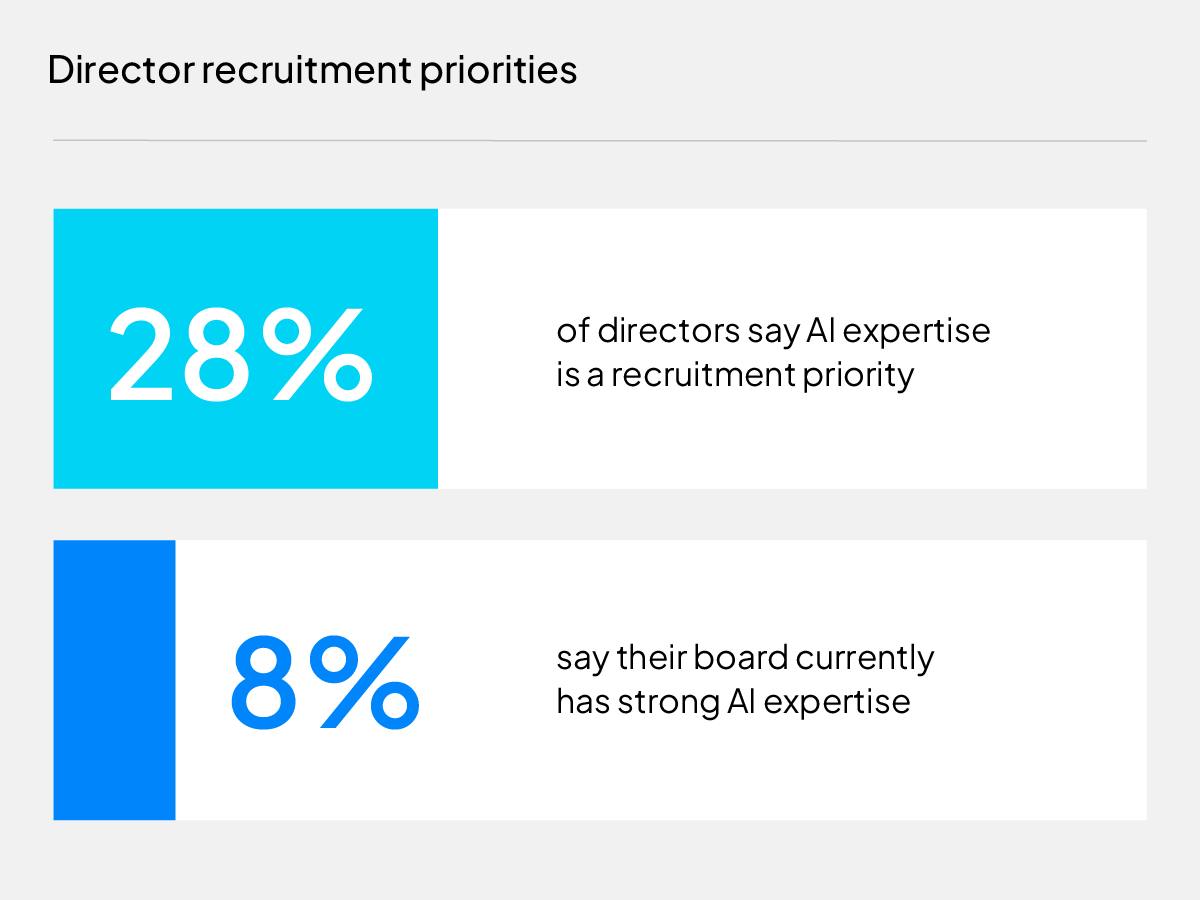
Succession planning is not just about replacing departing directors — it is about recruiting for capabilities the board does not yet have. A board skills matrix makes that gap visible by mapping current director expertise against where the business and its risks are heading.
A board whose members all have similar backgrounds and skills, with little variety in experience, is unlikely to be as effective as it can be. Always consider diversity, including gender, race, beliefs, age and more. This introduces new perspectives and ideas and helps the business make better decisions.
Ask your board to be transparent, so you know when there may be an upcoming vacancy. This may be due to them being offered a position elsewhere, retirement, or something else. Board departures cannot all be foreseen, but openness and honesty should always be encouraged.
If you've followed the previous steps, you'll now be in a solid position to identify which candidates will slot into your board well. This includes ensuring diversity and filling gaps in skills. It also means you can continue to push towards your goals and objectives. Whether these roles become available in the near- or medium-term future, you'll be prepared once opportunities arise.
Treat board succession planning as continuous work that protects the future of your business. Like every other important action, it can come with challenges that you need to address.
Boards commonly face five challenges:
1. Resistance to change can come from fear of the unknown or risks of upsetting the status quo. This can prevent proactivity and lead to delays down the line if not addressed ahead of time. The board must encourage open communication and the benefits must be emphasized to ensure the long-term stability of the business.
2. Suitable candidates can be difficult to identify once you know the skills and experience required. Finding those who have these and align with your organization's culture and values can be tricky. It's also possible that you'll find the perfect candidates, but then their priorities and availability will change.
3. Knowledge transfer can make getting new board members up to speed a long and complicated process. This includes the history of the business and specific operational nuances. A mentorship program can help with this, as can complete 'user notes' that new board members can use as a reference.
4. Diversity concerns can make it difficult to ensure diversity in your board of directors due to biases or limited networks. Your usual recruitment processes can also contribute. This can impact decision-making and can limit new ideas and innovations. Consider reevaluating your recruitment processes and highlighting your desire for a more diverse and inclusive board.
5. Timing and planning can be difficult because identifying and developing future board leaders can be a long process and is one where decisions shouldn't be taken lightly. As a result, you may be forced to make a rushed decision if you don't give yourself enough time which may result in recruiting a board member that doesn't align with your organization's needs.
These four practices help boards keep succession planning active and accountable:
By not assigning roles and responsibilities to specific board members, you risk things not getting done. Accountability is key, so give board members roles and timeframes to keep the process moving. Because change can happen quickly and at any time, proactively thinking about the board's future helps prevent issues and delays down the line, which can have a huge negative impact.
Use data to identify what your business lacks and what it needs to meet its goals. That includes skills gaps and diversity needs. It also includes the board's understanding of emerging technologies and practices.
You must undertake regular board evaluations so you can spot opportunities for improvement as early as possible. Any decisions you make should be for the benefit of your organization and its goals and objectives.
While the process should be confidential, complete openness among all board members is critical. This helps with communication and trust, which leads to better decision-making.
Certain parts of the succession planning process may be less effective without the right technology. Spreadsheets and notepads will only get you so far.
The implementation of new tools and technologies, such as board evaluation software, keeps processes organized and efficient. This allows you to get all the data you need to make impactful decisions in less time.
Meghan Day, Principal Solution Designer at Diligent, says, “Technology helps keep processes fast, efficient, accurate and simple to understand. This allows boards to make data-driven decisions far more quickly, which frees up their time for other tasks. This is especially true of the board succession planning process, which is often long and drawn out. Technology makes each step faster and helps support continuity for an organization.”

Boards can build a strong pipeline of talent by proactively identifying potential board leaders and dedicating resources to their development. A well-planned and executed board succession process supports smooth transitions and continuity in leadership.
Board succession planning is an ongoing process. Regularly review and update your plan to reflect changes in the organization's needs and the board's composition. Consider the broader business environment as you make those updates. According to Diligent Institute's Top Board Trends in 2026, effective succession planning should be continuous and discussed at every meeting, with directors knowing the pipeline at least one level down and preparing for unexpected transitions — including mission-critical roles beyond the CEO.
Assign ownership, review pipeline gaps and update the plan regularly so your organization remains well-governed and prepared for long-term needs.
Succession planning breaks down for a simple reason: it is often undocumented, ad hoc and disconnected from the board composition data that should be driving it. A skills matrix lives in one spreadsheet, candidate notes live in someone's inbox and the plan itself only gets revisited when a vacancy is already urgent.
Diligent Market Intelligence gives boards and nominating and governance committees a structured way to assess current board composition against strategic needs, identify skills gaps and future directorship requirements, and benchmark board structure and practices against peers — turning succession from a subjective conversation into a data-backed one.
Diligent Boards centralizes the policies, materials and workflows that keep succession planning organized, secure and ongoing rather than a once-a-year scramble. Its Document Library gives succession policies and candidate materials one secure home, the Action Tracker converts board succession discussions into commitments with named owners and due dates, Board Messaging supports secure communication around sensitive candidate conversations, and audit trails preserve a governance record of succession decisions.
Neither tool replaces the board's judgment. Both make the process the board already owns easier to keep continuous and defensible.
Board succession planning is the ongoing process of identifying, developing and preparing future board members to fill vacancies from planned or unexpected director departures. It matters because it protects continuity of leadership, keeps the board's skills aligned with where the business is heading and signals mature governance to investors and regulators. Boards that treat it as a one-time exercise typically fall behind boards that treat it as continuous work.
Succession planning should be a standing topic, not an annual event. Directors should know the leadership pipeline at least one level below the CEO at all times, and the plan itself should be revisited whenever board composition, strategy or risk exposure shifts — not only when a vacancy becomes urgent. Building a brief succession check into a regular board or committee meeting keeps the plan current without adding a separate process.
At minimum, a board succession planning policy should define who owns the process, how often it is reviewed, how candidates are identified and vetted, and how the board handles both planned and emergency transitions. For a full breakdown of what to include and how to structure the document, see our board succession planning policy guide.
A skills matrix maps each current director's expertise and term against the skills and experience the board will need going forward, making gaps visible before they become vacancies. Rather than reacting to a departure, the nominating and governance committee can use the matrix to recruit deliberately for capabilities the board does not yet have — AI expertise, cybersecurity, international operations or whatever the strategy demands next.
The nominating and governance committee typically owns the succession planning process day to day: maintaining the skills matrix, identifying and vetting candidates, running board self-assessments and bringing recommendations to the full board for discussion and approval. The full board retains final say on new directors and on the succession policy itself, but the committee is what keeps the process moving between those decision points.
Use a proactive approach to identify potential board leaders by regularly assessing the board's current skillset and identifying any areas where additional expertise may be needed. Consider factors like industry knowledge, financial acumen, legal background, and technological fluency. This analysis helps define the ideal profile for future board members.
Other useful tools include:
Qualified board candidates may come from current board networks and executive leaders. Industry associations and search firms can also help.
Once potential candidates are identified, active development is important:
Assess each candidate carefully so you select the most qualified candidate for the board. Consider:
Onboarding new board members ensures a smooth transition and helps them contribute to the board. Key elements of effective onboarding include:




