
In this article

The compensation committee determines all executive compensation packages, including salary and any other forms of compensation. Depending on the company’s bylaws and the compensation committee's charter, the committee will either have the authority to decide the amounts and components for executive compensation packages on its own or make strategic recommendations to the board for a final vote.
Corporate boards are highly regulated and have a lot of pressure from investors who want assurance that executive pay correlates to performance. The modern compensation committee determines executive compensation packages while managing investor expectations, regulatory compliance and proxy advisor scrutiny.
Beyond setting salary levels, these committees must design incentive structures that align executive behavior with long-term company performance, disclose compensation rationale in proxy statements and engage proactively with shareholders on pay decisions.
To help you understand and properly utilize your compensation committee, this article will explain:
The compensation committee is a standing board committee composed of independent directors responsible for determining executive compensation packages and ensuring pay aligns with company performance and shareholder expectations.
This committee operates independently of management, with authority to make strategic recommendations or final decisions on executive pay, subject to the company's bylaws and committee charter.
The current environment around executive compensation requires boards to appoint compensation committees comprised solely of independent directors. The appointees should collectively represent diverse business skills and industry expertise.
A compensation committee is typically composed of at least three directors, with all members required to be independent according to the listing standards of major U.S. stock exchanges (such as NYSE and NASDAQ).
While these standards are not set directly by the SEC, they are consistent with SEC disclosure requirements for compensation committees.
Among public company directors surveyed in the What Directors Think 2025 report by Diligent Institute, Corporate Board Member and FTI Consulting, 38% serve on compensation committees, with 24% as committee members and 14% as committee chairs.
This widespread involvement reflects the committee's central role in governance, though only 12% of directors rate executive compensation as their biggest challenge — suggesting that well-structured committees can navigate compensation decisions effectively.
Committee members should have relevant skills and experience that make them qualified to research, assess and recommend executive compensation plans. Common qualifications among compensation committee members include experience with:
The components of compensation plans, as well as how those components are structured and implemented, vary substantially between corporations. Compensation trends often evolve, but compensation plans commonly consist of one or more of the following components:
Modern compensation committees manage responsibilities that extend far beyond traditional pay-setting.
While determining executive salary and benefits remains foundational, committees now navigate complex regulatory requirements, shareholder activism and proxy advisor scrutiny that make compensation decisions increasingly public and contentious.
The committee develops a philosophy around compensation in keeping with the corporation's mission and values. This incorporates the ratio of salary to benefits, competitiveness, correlation to business strategy, drivers for increases or incentives and how the philosophy affects employee morale and job satisfaction.
This philosophy must address contemporary expectations around pay-for-performance alignment.
Research from Georgia State University reveals that around 25% of firms exploit regulatory discretion to present favorable pay ratios without reducing actual executive compensation — creating misleading disclosures that satisfy technical compliance while obscuring workforce compensation realities.
For compensation committees, maintaining credible stakeholder relationships requires transparent compensation philosophies that genuinely link pay to performance metrics.
The compensation committee's primary authority includes:
While the committee bears authority for compensation decisions, consistent pressure from investors requires committee members to establish clear performance targets and mechanisms for measuring whether executives have met their benchmarks.
Shareholders want to know how the board is approaching its compensation design — a story that the compensation committee is expected to tell in the Compensation Disclosure & Analysis (CD&A) section of the proxy statement.
Investors are also pressing boards to think about how compensation decisions can impact the company's long-term strategy for growth, whether negatively or positively.
Today's compensation committees must prepare for say-on-pay votes, where shareholders approve or reject executive compensation packages.
The committee also manages engagement with proxy advisory firms like ISS and Glass Lewis, whose recommendations significantly influence institutional investor voting.
Understanding how proxy advisors evaluate executive compensation — including peer group selection, performance metrics and pay ratio calculations — enables committees to design compensation programs that satisfy both regulatory requirements and investor expectations.
Effective committees compile and analyze comprehensive compensation data to ensure executive pay remains competitive while aligned with company performance. This includes:
The committee should have access to the same data their investors have, plus tools that enable peer group modeling and scenario analysis.
Compensation consultants typically play an important role in both compensation strategy and disclosure, advising committees on peer group selection and incentive design, often through the lens of investors and proxy advisors.
The committee recommends, oversees and approves:
The committee reviews board members' compensation components and amounts and recommends changes to the board. The board considers their recommendations and votes on them according to their duty of care, which means placing the organization's interests above their own.
This responsibility has grown more complex as shareholders scrutinize director compensation alongside executive pay.
Compensation committees must balance competitive director compensation — necessary to attract qualified independent directors — with shareholder expectations for reasonable board pay levels.
To be effective, compensation committees need to excel in many different areas. They have to liaise with the board, executives, shareholders and any external stakeholders that assist the process.
Whether a company's CEO compensation is high or low is always relative. Peer group selection is a critical part of the compensation committee process; proxy disclosure should:
Today's boards must use the CD&A to tell their company's pay story. Compensation committee members should also be prepared to engage with shareholders on the topic of CEO pay.
"At least once a year, put your activist hat on and look at your potential vulnerabilities from an outside-in activist viewpoint," says Catherine Morris, Director at PJT Partners. "What are the proactive measures you can take about refreshing your board, improving disclosures and so on?"
Proactive engagement prevents say-on-pay failures. Boards that communicate compensation philosophy and respond to investor concerns before proxy season significantly improve approval rates compared to reactive approaches.
Compensation consultants typically play an important role in both the compensation strategy and disclosure; they advise compensation committees on peer group selection and incentive design, often through the lens of investors and proxy advisors.
When engaging consultants, committees should ensure consultant independence — avoiding conflicts where the same firm provides both executive compensation advice and other services to the company.
The success of today's compensation committees relies on whether they have the right data at their fingertips. Committees need access to:
Access to reliable data enables committees to defend compensation decisions with evidence, model different scenarios and anticipate shareholder reactions before finalizing pay packages.
The compensation committee needs to function independently from the board. Be sure to choose impartial committee members and limit how long each member serves to limit any bias.
"Long-tenured boards are perceived to no longer be fully independent," says Jon Solorzano, Counsel - Environmental, Social & Governance at Vinson & Elkins. "But the counter-argument is the board has been through multiple cycles and multiple CEOs. On the flip side, having a totally new board isn't ideal either. There's no institutional memory. You need to find the right balance of tenure."
Independence extends beyond tenure considerations. Committee members should:
The board should have an open line of communication with the compensation committee. This provides assurance that the committee is operating legally, ethically and in the best interest of the company.
"The board fundamentally has to trust management," says Inna Barmash, Chief Legal Officer & Corporate Secretary at Amplify. "Trust starts with communication. Communication is successful when it's proactive, when it anticipates and addresses board members' concerns and speaks to their experience from other boards and their operational experience."
Regular reporting creates accountability and ensures alignment between committee decisions and overall board strategy. Committees should provide updates on compensation philosophy, market trends affecting pay decisions, consultant recommendations and upcoming proxy disclosure requirements.
Download Diligent's Executive Compensation in 2025 report for analysis of shareholder voting behavior.

Say-on-pay votes have transformed from procedural formalities into high-stakes corporate governance events that can trigger shareholder activism, leadership changes and reputation damage.
Compensation committees must approach these votes strategically, understanding both the mechanical requirements and the investor sentiment driving voting decisions.
Dodd-Frank provisions require public companies to hold non-binding shareholder votes on executive compensation at least every three years, with most companies conducting annual votes.
While these votes are advisory rather than mandatory, failures send powerful signals:
Proxy advisory firms evaluate executive compensation using sophisticated frameworks that compensation committees must understand:
Understanding these frameworks enables committees to design compensation programs that satisfy both regulatory requirements and the analytical criteria that drive institutional investor voting.
Leading compensation committees engage investors year-round rather than waiting for proxy season:
This proactive approach builds investor trust and enables committees to address concerns before they crystallize into negative votes.
AI-powered governance platforms address the data access, analysis and documentation challenges that compensation committees face when managing complex benchmarking, proxy disclosure and shareholder engagement requirements.
Diligent Market Intelligence delivers the shareholder activism and proxy voting data compensation committees need to design executive pay plans that withstand scrutiny:
Additionally, customizable dashboards amalgamate critical information on a single screen. This ensures that committees never miss developments in activism, voting and governance trends that affect compensation decisions.
The Diligent One Platform centralizes compensation committee workflows, board reporting and proxy preparation within an integrated governance infrastructure.
Board-ready reporting templates translate complex analysis into concise summaries, while secure collaboration tools enable committee members to reach consensus through encrypted channels.
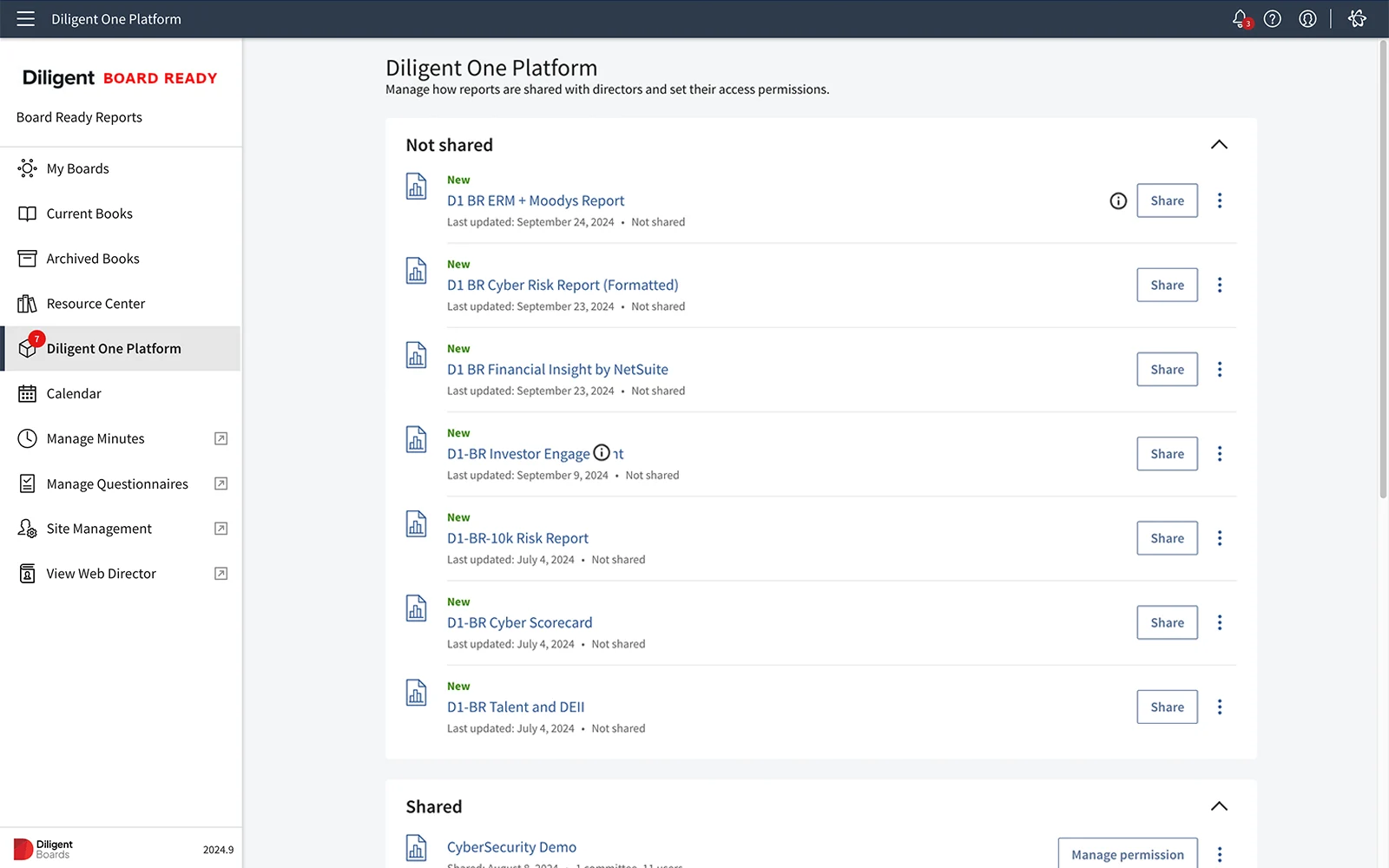
Document version control maintains audit trails supporting proxy disclosure narratives that explain committee deliberation processes.
With these tools, Diligent transforms compensation committee effectiveness through comprehensive benchmarking, predictive modeling, and unified collaboration that streamlines decision-making from analysis to disclosure.
Ready to elevate your compensation committee's strategic impact? Request a demo to see how leading organizations achieve higher say-on-pay support with Diligent's solutions.
Committee members should have demonstrated experience in senior management, human resources, compensation design or employee benefits.
Increasingly, boards seek members with specific expertise in performance metrics, equity compensation structures or regulatory compliance. All members must meet strict independence requirements with no material relationships to the company beyond board service.
Leading committees engage shareholders year-round through investor relations outreach, pre-proxy consultations on draft CD&A narratives and post-vote follow-up with significant opposing voters.
This proactive engagement builds trust and enables committees to address concerns before they manifest as failed say-on-pay votes or activist campaigns.
Compensation consultants advise committees on market trends, peer group selection, compensation structure design and proxy disclosure strategy.
Consultants should report directly to the committee (not management) to maintain independence. The committee should periodically assess consultant independence, ensuring firms don't have conflicts from other business relationships with the company.
Most committees meet quarterly, with additional meetings scheduled around proxy season, say-on-pay votes and CEO performance evaluations.
Complex compensation decisions — such as major incentive plan redesigns or post-merger integration compensation — may require more frequent meetings with shorter notice periods.
Request a demo to see how Diligent empowers committees with real-time benchmarking, proxy advisor modeling and integrated governance workflows.