
In this article

An assurance report evaluates whether an organization’s processes, controls or disclosures meet defined standards. As regulatory scrutiny intensifies and stakeholders demand greater transparency, the ability to produce and respond to assurance reporting has become a critical governance competency.
Usually triggered by SOX compliance obligations, ESG disclosure requirements or investor due diligence, organizations across every industry face growing pressure to demonstrate that their claims hold up to independent examination.
Whether you’re preparing for a third-party assurance engagement, strengthening internal controls or navigating new sustainability disclosure requirements, understanding how the assurance reporting process works and how to prepare effectively is essential to building stakeholder confidence.
This comprehensive guide covers everything you need to know about assurance reports, from foundational concepts to practical preparation strategies:
An assurance report is the formal output of an independent evaluation, conducted by a qualified practitioner, that communicates whether a specific subject matter (such as financial controls, sustainability data or regulatory compliance) meets established criteria. The report provides stakeholders with a professional conclusion about the reliability and accuracy of the information under review.
At its core, assurance reporting exists to build trust. When a requesting party hires an independent firm to provide assurance services, they are seeking third-party validation that their organization’s claims, processes or data meet the standards they purport to follow. The resulting assurance report becomes the formal record of that evaluation.
Not all assurance engagements provide the same level of confidence. The two primary types differ significantly in scope, depth and the certainty of their conclusions.
Reasonable assurance engagements involve extensive procedures: detailed testing, comprehensive evidence gathering and thorough analysis. The practitioner’s conclusion is expressed in a positive form, such as “In our opinion, the subject matter is in accordance with the criteria.” This level of assurance reduces engagement risk to an acceptable level, comparable to a financial statement audit.
Limited assurance engagements use fewer procedures. The practitioner’s conclusion is expressed in a negative form: “Based on our work, nothing has come to the attention that causes us to believe the subject matter is materially misstated.” While still valuable, this provides less confidence than reasonable assurance.
The choice between these levels depends on regulatory requirements, stakeholder expectations and cost considerations. Many organizations start with limited assurance for emerging areas like ESG reporting and transition to reasonable assurance as their processes mature.
Assurance reports serve multiple stakeholders across the governance ecosystem. Boards of directors and audit committees request them to validate management’s assertions about controls and compliance. Investors and lenders may require assurance as a condition of financing or ongoing reporting. Regulators mandate them in specific contexts, from SOC 2 reports for service organizations to SOX attestations for public companies to sustainability assurance under emerging disclosure frameworks.
Internally, organizations also use assurance engagements proactively. Forward-thinking governance teams commission voluntary assurance reviews to identify gaps before regulatory examinations, strengthen credibility with stakeholders and demonstrate commitment to transparency. This proactive approach has become particularly relevant as boards expand their oversight beyond traditional financial reporting.
Assurance engagements operate within structured professional frameworks that define how practitioners plan, execute and report their work. Understanding these standards helps organizations prepare effectively and interpret assurance conclusions with confidence.
The International Standard on Assurance Engagements 3000 (Revised), issued by the International Auditing and Assurance Standards Board (IAASB), is the foundational global standard for non-financial assurance work. It covers engagements involving sustainability reports, internal controls, regulatory compliance and any subject matter beyond traditional financial statement audits. ISAE 3000 establishes principles for ethical behavior, quality management, and performance in engagement that apply across all assurance contexts.
The standard recognizes two types of reports. A Type 1 report provides assurance on the suitability of design and the existence of controls at a specific point in time. A Type 2 report goes further, covering the operational effectiveness of those controls over a defined period. Organizations undergoing service organization audits (such as SOC 1 or SOC 2 engagements) will encounter this distinction frequently.
The IAASB approved ISSA 5000 in November 2025, with an effective date of December 15, 2026. This new standard is specifically designed for sustainability assurance engagements, addressing the unique challenges of ESG data including forward-looking information, value-chain data and qualitative disclosures that existing standards weren’t built to handle.
For organizations currently using ISAE 3000 for sustainability assurance, the transition to ISSA 5000 represents a significant shift. Governance teams should begin familiarizing themselves with the enhanced requirements now, particularly around data systems and internal controls that support sustainability reporting.
Beyond ISAE 3000 and ISSA 5000, several other standards govern specific types of assurance work. ISAE 3402 addresses assurance reports on controls at service organizations (the international equivalent of SOC reports). AAF 04/06 provides guidance on risk and liability considerations for assurance reviewers in specific jurisdictions. National standards like those from AICPA (U.S.) and ICAEW (U.K.) also apply depending on the engagement’s geographic context.
The common thread across all frameworks is the emphasis on independence, professional skepticism and sufficient appropriate evidence. Regardless of the standard in play, the assurance practitioner must maintain objectivity and gather enough evidence to support their conclusion.
Trust is paramount in any industry. However, sometimes changes occur or questions arise that prompt managers, owners and other company stakeholders to confirm the validity of an organization’s business processes and adherence to governance standards. To get that information, they may request a review from a firm that offers assurance services. Assurance reporting summarizes results from that evaluation that determines whether the organization succeeded at meeting the assurance objective.
When a requesting party hires a firm to provide assurance services, they must define the subject matter at the heart of the request. The assurance reviewer must understand the reasoning behind requesting the assurance report and the requestor’s relationship with the entity under investigation. That helps them understand the criteria upon which they should base their assurance report conclusions.
After establishing the scope of the investigation, the requestor must outline the terms under which the assurance reviewer should produce their report in an engagement letter. Both the requestor and reviewer must agree to the terms of the letter. These terms will form the basis of the investigation. Therefore, the language of the engagement letter must:
After reviewing all essential information, the reviewing assurance services firm provides a report that includes the criteria used to evaluate the requestor's claims and descriptions of any limitations encountered during the review.
“Trustworthiness to the board is key for Chief Audit Executives. The power of analytics allows us to move beyond guesswork and provide concrete, data-backed answers,” says Michele Variale, Chief Audit Executive at Telepass. This perspective underscores the growing importance of data-driven approaches to assurance work.
To produce an accurate report, the assurance reviewer must first consider whether statements or assertions made by the requestor are appropriate. In addition, the assurer must question the requestor about any errors, misstatements, or other issues that might skew the results.
If there is a problem, then the requestor may take the opportunity to change their statements or update supporting documentation. However, if the requestor refuses to make the necessary changes, the reviewer must account for that in their assurance report.
When an assurance reviewer accepts an assignment, they must take steps to ensure they adhere to their industry’s ethical and professional standards. In addition, the evaluator must make every effort to carry out their legal, contractual, professional, or regulatory responsibilities.
In the end, the assurance reviewer's final report must conform to the standards outlined in the engagement letter. In addition, the reviewer should provide supporting documentation on how they arrived at their assurance conclusion. The assurance report should make clear:
Additional information that the assurance report must include includes restrictions on the reproduction of some or all of the report and supporting documents. Assurance reviewers can use guidelines outlined in AAF 04/06 (risk and liability) when determining restrictions to place around distributing, using and relying on the report. Industry regulations and contractual terms may affect the assurance reviewer's decisions regarding the availability of the report and its distribution.
Assurance reporting has expanded well beyond its traditional roots in financial statement audits. Organizations now seek independent assurance across a broad range of governance, risk and compliance activities, each with distinct requirements and stakeholder expectations.
The breadth of these use cases underscores an important point: Assurance readiness isn’t a one-time exercise. Organizations that maintain strong governance infrastructure and documentation practices are better positioned to respond to any type of assurance engagement with confidence.
See how governance teams reduce compliance overhead while improving oversight quality and assurance readiness.

When drafting the assurance report, the assurance reviewer must maintain awareness of how they use and apply specific language throughout the document. For example, language that implies insurance – including words like opinion or conclusion – should only appear concerning the subject matter outlined in the engagement letter.
In addition, the wording an assurance reviewer uses to discuss issues related to the subject matter – like processes and controls around information flows – should be distinct from the language used to write the assurance conclusion. A better practice might be to create a separate, private report to outline those conclusions and provide it to management as a separate highlights memo. You can also turn the observations into a separate appendix to the assurance report that clarifies that the information did not affect the reviewer’s final assurance conclusion.
Standard requirements around the language a reviewer should use in an assurance report include:
To maintain a proper level of consistency around language, the assurance reviewer should initiate discussions with clients around the wording to use within the report and the assertions that form the basis of the assurance review.
Sometimes the evidence uncovered during the assurance does not meet the levels required to issue a specific conclusion. That can be due to:
If there’s not enough evidence present, that shouldn’t be a reason for the reviewer to make changes to the scope of the engagement. Instead, they must decide whether they will:
Other responsibilities the assurance reviewer must consider is whether information related to governance should be elevated to the attention of those charged with governance oversight. In addition, the reviewer should consider the information given to them by the client or other users and possibly highlight information that conflicts with the assurance report’s conclusion. The reviewer should only sign off on an assurance report if they have sufficient evidence to support the assurance conclusion.
A qualified conclusion indicates that, except for specific identified issues, the subject matter conforms to the criteria. An adverse conclusion states that the subject matter does not conform. A disclaimer means the reviewer was unable to gather enough evidence to form any conclusion. Each of these carries different implications for the organization and its stakeholders.
“Be proud of your transparency. If you don’t have reporting, it’ll end up on Glassdoor, it’ll end up on the press, it might even end up with a human life cost,” says Anastassia Lauterbach, a governance leader and experienced board director. While her comment addresses corporate culture broadly, the principle applies equally to assurance engagements: transparency is always the stronger position.
As part of the assurance investigation, the reviewer might come across evidence of fraud, illegal acts, or other errors tied to an organization’s systems, employees, or managers that affect areas responsible for interacting with users.
It’s the requestor’s responsibility to figure out whether those issues were properly disclosed to affected users. If that doesn’t happen, then the assurance reviewer must decide whether to take the conclusions to someone of equal or higher authority to the requestor, resign from the engagement or pursue another action.
Effective preparation is the difference between a smooth assurance engagement and a painful one. Organizations that invest in readiness before the reviewer arrives consistently achieve cleaner conclusions and spend less time managing the process.
Before any assurance engagement, ensure your policies, procedures and controls are documented clearly and accessible. The reviewer will need to understand your control environment, risk assessments and monitoring activities. Organizations that rely on institutional knowledge rather than formal documentation face immediate challenges when assurance reviewers request evidence.
According to Diligent Institute’s Transaction Readiness Report, 60% of organizations report their GRC and financial systems are either completely siloed or only partially integrated. This fragmentation makes it significantly harder to produce the comprehensive evidence trail that assurance reviewers require.
Assurance engagements touch multiple departments. Finance, legal, compliance, IT and operations may all need to contribute documentation or participate in interviews. Designate a point of contact to coordinate the engagement and ensure each team understands their role in the process. Cross-functional coordination consistently emerges as an improvement area, with 44% of compliance leaders identifying it as a gap in the Q4 Business Risk Index.
Before the formal engagement begins, conduct your own gap analysis against the criteria the assurance reviewer will use. Test your controls internally, identify areas where documentation may be weak and address any issues proactively. This approach mirrors how the most effective internal audit teams operate: finding and fixing problems before external reviewers discover them.
The most resilient organizations don’t treat assurance preparation as a periodic scramble. They build governance infrastructure that maintains continuous readiness through real-time monitoring, automated evidence collection and integrated control frameworks that keep documentation current at all times.
This shift from periodic preparation to continuous readiness has become especially important as assurance demands expand. Between ESG disclosure requirements, cybersecurity governance expectations and traditional financial controls, organizations face overlapping assurance needs that share common evidentiary foundations. Building that foundation once and maintaining it continuously is far more efficient than reconstructing it for each engagement.
The assurance challenges documented throughout this guide (fragmented documentation, siloed GRC systems, resource-intensive preparation and inconsistent evidence trails) are precisely the problems that AI-powered governance platforms address. Technology doesn’t replace the assurance reviewer’s professional judgment, but it fundamentally changes how organizations prepare for and manage assurance engagements.
Diligent’s Internal Audit solution transforms audit operations from manual, sampling-based processes to AI-powered assurance that covers 100% of relevant data. Rather than spending weeks compiling workpapers and testing individual controls manually, audit and assurance teams can automate documentation, streamline evidence collection and deliver comprehensive findings through real-time dashboards.
For organizations managing multiple overlapping assurance requirements, from SOX compliance to ESG reporting to service organization audits, this capability is transformative.
ACL Analytics extends these capabilities by enabling continuous monitoring and risk-based testing across any data source. Instead of periodic sample-based reviews, organizations can run automated analytics that detect anomalies, fraud indicators and control exceptions continuously. This shift from periodic to continuous assurance directly improves the evidence trail available when external reviewers arrive, reducing the time and disruption of formal assurance engagements.
For organizations managing governance and compliance across multiple jurisdictions and frameworks, the Diligent One Platform provides the unified infrastructure that assurance readiness requires. By connecting risk assessments, compliance monitoring, audit findings and entity management through shared data models, the platform eliminates the fragmented documentation that leads to assurance qualifications and creates the single source of truth that reviewers expect.
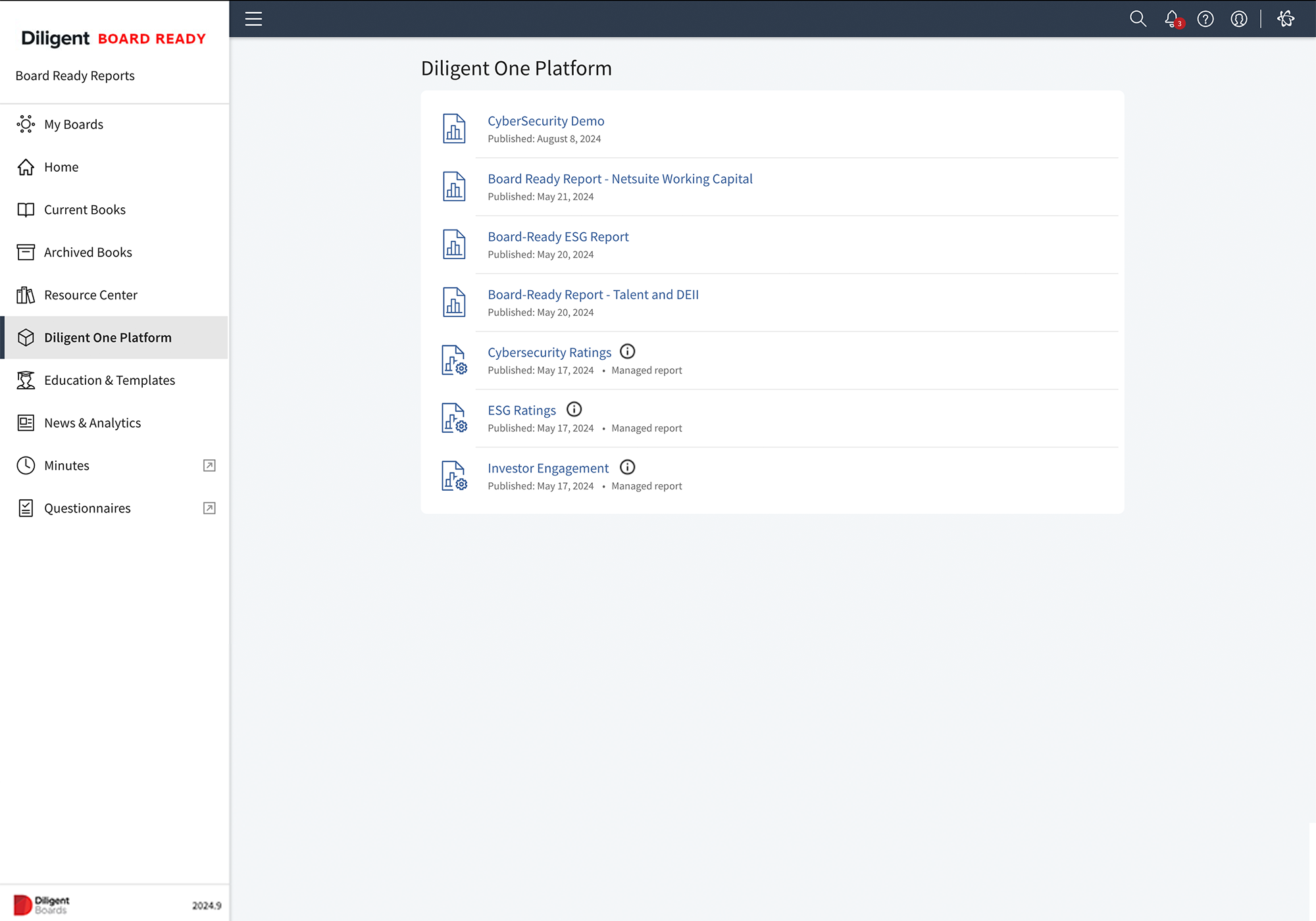
The result is assurance readiness that scales with organizational complexity rather than requiring proportional increases in governance staff. This is critical for organizations managing expanding oversight requirements across an increasingly demanding regulatory landscape.
See how leading governance teams maintain audit-ready controls, streamline evidence collection and eliminate the scramble before assurance engagements. Schedule a demo
An audit report specifically addresses financial statements and is conducted under auditing standards (such as ISAs). An assurance report covers a broader range of subject matters, including internal controls, sustainability data, regulatory compliance and IT systems, and is conducted under assurance standards like ISAE 3000. While financial audits provide reasonable assurance by default, other assurance engagements may provide either reasonable or limited assurance depending on the engagement terms.
A complete assurance report should include an identification of the subject matter and criteria used for evaluation, a description of the assurance practitioner’s responsibilities, the scope and nature of work performed, any limitations encountered, the assurance conclusion (positive or negative form depending on level) and details about who can access and rely on the report. Restrictions on distribution and reproduction should also be clearly stated.
Timeline varies significantly based on scope, complexity and organizational readiness. A limited assurance engagement over a well-documented subject matter might take four to six weeks. Reasonable assurance engagements over complex areas like enterprise-wide internal controls can take three to six months or longer. The most significant variable is the organization’s preparation; well-documented controls and accessible evidence dramatically reduce engagement time.
ISSA 5000 is the IAASB’s purpose-built sustainability assurance standard, approved in November 2025 and effective for engagements beginning on or after December 15, 2026. It replaces ISAE 3000 as the applicable standard for sustainability-specific assurance, with enhanced requirements for forward-looking information, value-chain data and qualitative disclosures. Organizations currently obtaining sustainability assurance under ISAE 3000 should begin preparing for the transition now.
Yes. Many organizations commission voluntary assurance engagements to identify governance gaps before regulatory examinations, build stakeholder confidence and strengthen internal processes. Proactive assurance can also support transaction readiness, as potential investors and acquirers increasingly expect independent validation of governance and compliance claims during due diligence.
Ready to strengthen your assurance readiness? Schedule a demo to see how Diligent’s AI-powered governance platform helps your organization maintain continuous compliance and control visibility.